Nomads and the Future of Indian Festival Culture
Nomads at Abheygarh Khetri: Mapping a more intentional future for Indian independent music
Somewhere in the middle of his set at Nomads, Abhishek Bhatia, who records and performs as Curtain Blue, threw rose petals into the crowd. The gesture was tied to the song Kesar, half-planned and half-leap. “I was a bit iffy about it because what if people don’t want that? But I really wanted to, and I went for it,” he told us. Many sought him out later in admiration.
It was a rare moment of theatrical gamble that a certain kind of festival either makes possible or doesn’t.
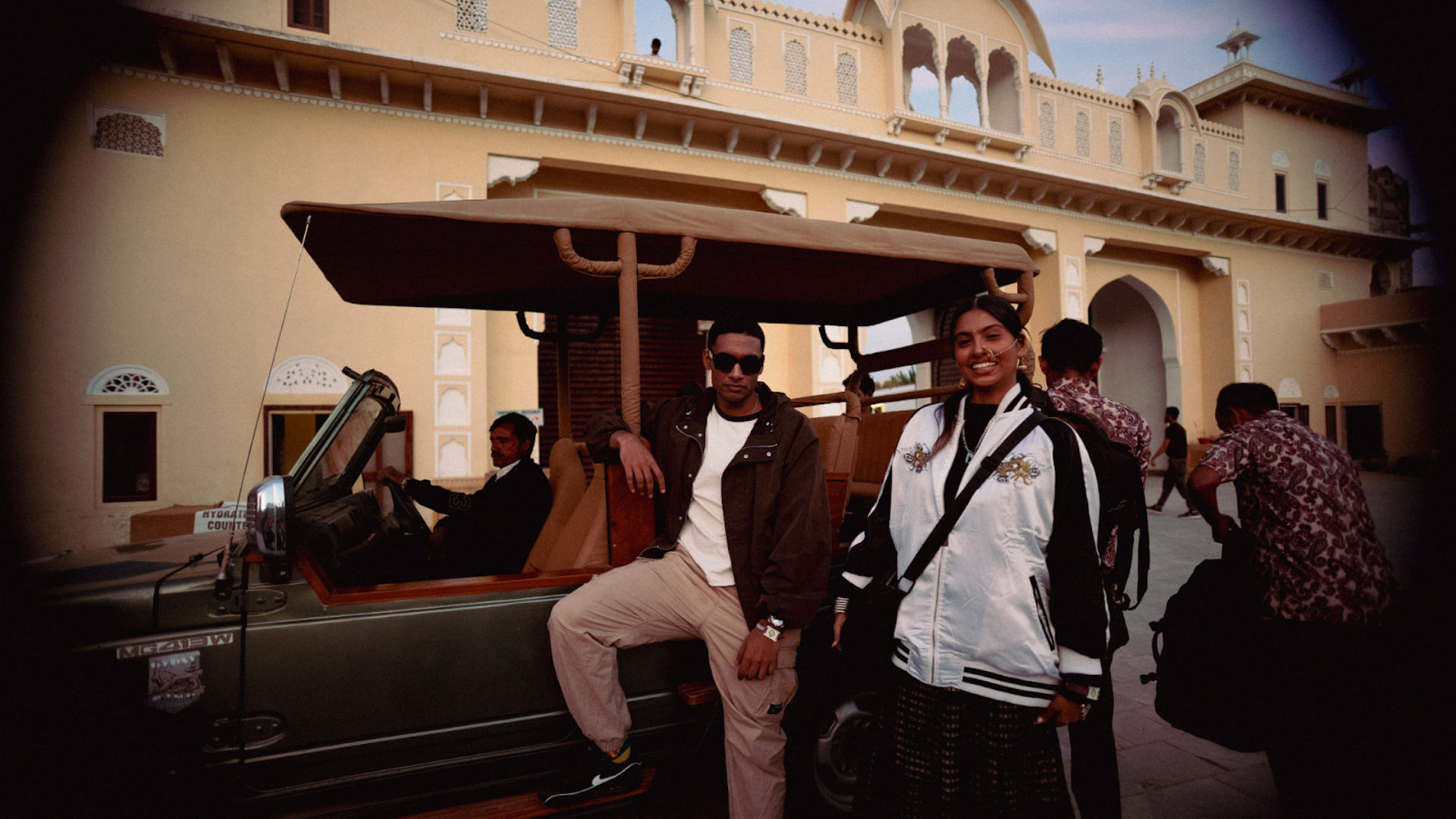
Nomads by Magnetic Fields Festival India made its full-scale debut in February 2026 at Abheygarh Khetri in Rajasthan, a new hotel built in the vocabulary of the state’s regal heritage buildings. Think arched colonnades catching the afternoon light, reflected in the eyes of the festival goers, heavy with sleeplessness and joy both. There’s something quietly counterintuitive about a festival that asks its audience to slow down.
The lineup of Nomads makes the argument more plainly than any programming note could. Vieux Farka Touré, the Malian guitarist known as the Hendrix of the Sahara, performed his desert blues at the Jameson Connects West Stage with the Aravalli Hills rolling green behind him. Barker brought a live ambient set to The Stepwell, the Rajasthan music festival’s dedicated downtempo space, his presence alone signalling that this is a circuit serious artists are paying attention to. Jal, Jungle, Zameen — a transmedia performance by Murthovic and Thiruda — placed hereditary folk musicians from Rajasthan alongside live electronica inside the very landscape their music came from. Rival Consoles, the Auntie Flo Band, 1-800 GIRLS; the conversation happening at Nomads is global, and it is happening in Rajasthan.
“With Nomads, we wanted the opposite feeling to the typical festival experience, something more spacious and reflective,” Munbir Chawla (Co-founder, Music & Partnerships Director) told Jameson Connects Jam Radio. “In terms of programming that meant leaning towards immersion, longer sets, and an experience that overall feels cohesive.”
Navigating Nomads Festival 2026 On the Ground
The Stepwell, the ambient and downtempo stage, is the most vivid expression of that; music that usually exists at the margins of a festival lineup was given the space to unfold properly. “It’s always a risk to centre something that traditionally sits at the fringes,” Munbir said. “Our experience with the Magnetic Fields community showed us that audiences are increasingly open to newer sounds and deeper listening.”
The same logic moves through all eight stages at Nomads, live bands basking in the golden hour, club acts carrying the night deep into the early morning. Regional and classical influences bleed into R&B, soul, indie, electronic, as the day progresses. Parallel to the daytime music ran The Sanctuary: a room laid with kilims and candles, where practitioners used tuning forks and guided meditation. In practice, it offered a necessary hour of stillness in the middle of three days of music.
The Jameson Connects West Stage and the late-night Club are sonically miles apart, one catching the last of the daylight, the other running until the early hours in blue light and smoke, but both pushing the boundaries of live and electronic genres.
“The filter Jameson Connects applies when deciding where to show up is consistent: independent and non-mainstream. It’s less about a festival’s track record, and more about a longer read on where the culture was heading. That instinct shapes how Jameson Connects programmes its own spaces within a festival,” says Mo Joshi, co-founder of Azadi Records.
Ranj X Clifr on Their Nomads 2026 Debut
Ranj x Clifr played the West Stage on the first evening, joined by drummer Jason Sharat. Both came up through Kelvikkuri, a Carnatic jazz fusion band, before arriving at the R&B project they comprise now. Ranj describes the journey as moving from “musician’s musician to something concise enough that more people can come into the world.”
“Who they bring into the music is part of the sound itself. “When we were making Play Me!, we wanted to make an R&B project,” Ranj told us. “adL and Dappest and Meba Ofilia — the Shillong scene is the best in the country when it comes to R&B music. It’s a clean, sophisticated sound born from genuine friendship. We definitely need to like the person.”
The other axis is pure instinct.
“Sometimes there’s even an aspect of creativity involved in choosing your collaborator. Dhanji was a really creative call that Clifr made — but it was the most perfect collaboration.” At its simplest, Ranj says, it comes down to two things: “How much we like the person, how much we fuck with their music — and somehow making the right call for the song.”
“This was our first time playing our own set just as Ranj x Clifr,” Ranj says. “I wanted to just welcome people into our musical world. There’s always a lot of soul and emotion in our music anyway — and that’s what Nomads in general is about.” What completed it, Clifr says, was the lighting, Abhinav Khetarpal’s work shaping the visual atmosphere of each song. “Our set kind of peaked there,” he said, “because all the visual and sonic elements came out as intended.”
Curtain Blue on How their Performance at Nomads 2026 Came About
Meanwhile, Kesar, the upcoming Curtain Blue EP, has existed in some form for two and a half years, marked by the sprawling, emotive textures that have become Curtain Blue’s calling card. Kesar’s live premiere came about differently to how Bhatia had imagined. “It was perfect timing that I got the call to debut the EP there,” he told us. “I would definitely credit the festival’s timing for me wrapping up my live act and the lineup that I’m working with now.”
The band he pulled together: Ritwik De on guitar and production, Anshul Lall on drums, Chie Nishikori on trombone and trumpet, Harjinder Singh on sarangi.
Influenced by the digital melancholy of Radiohead and the mentorship of Gaurav Raina (of the Midival Punditz), Bhatia has spent years coaxing the sarangi and dholak into a dialogue with analogue synths.
“In the studio, I’m isolating the instruments — but live, the instrument kind of opens up and I like to keep it that way. Working with very dynamic instruments like the sarangi and trombone is quite tricky, but my band members know exactly where they want to play and where they want to hold back.”
Bhatia makes sure to big up the technical team that anchored the atmosphere for the band: Abhinav Patankar on sound and Abhinav Khetarpal on lights.
From Magnetic Fields Festival to Nomads 2026
Nomads has been building towards this deliberate approach since 2021, when a pilot edition in Ranthambore gathered 400 people around an all-Indian lineup. “The Ranthambore edition showed us that a smaller, more intentional gathering could still create a very powerful sense of connection,” Munbir said. What carried forward was the philosophy around intimacy and attentiveness. Almost everything else had to be reimagined for Abheygarh Khetri, which is larger than Alsisar, home to Magnetic Fields Festival India for ten years, and entirely different in character.
The debut edition sold out, but Munbir is unmoved by that as a metric. “For us, success is less about growth in numbers, and more about depth,” he said. “If the second edition feels even more cohesive, that’s the real measure.”
In a market often obsessed with “more, but fleeting,” Nomads has succeeded by offering an experience that is more considered and which “encourages presence rather than excess,” as Munbir puts it.
Nomads 2026 proved that a Rajasthan music festival could hold its own on the global electronic music festival stage. Somewhere between a Malian guitar and a Rajasthani sunset, it feels like India’s festival culture quietly grew up.
Akshai Sarin also captured the sonic soul of Abheygarh — read how he mapped the palace’s frequency here.
Aditi Dharmadhikari
Aditi is an independent writer, editor, and communications consultant for purpose-based organisations. She kicked off her career in Bombay as a culture writer writing about music, alternative culture, and gender; today, she works in impact storytelling, advising a diverse clientele in stories that most represent them. You can check out more of Aaditi’s work at Noughtsandcrosses.in
Jam Radio
Our Editorial Platform
Bringing you the best of culture, through exclusive stories from our community