STORY BY AMIT GURBAXANI

Akshai Sarin reveals sonic secrets at Nomads by Magnetic Fields with Jameson Connects

From palace doors to Sonokinesis, explore how Akshai Sarin unfolds a new way of experiencing the music within spaces.

Akshai Sarin sees sound where most of us don’t. The electronic music producer, composer and “technologist” has spent his career showing people how music can be created not just from voices and instruments but from everyday objects and the Earth itself.

If you Google the word ‘Sonokinesis’, the search results tell you that it’s the ability—possessed by several anime characters—to mentally manipulate sound waves. For Sarin, the term—which combines the Greek words for sound (‘sono’) and movement (‘kinesis’)—refers to a performance technique that brings together his love for music and technology. “[The idea for] Sonokinesis came from tapping a table and going, what if I could make music [from the sound]?”, says Sarin. “Then I was like, let’s try connecting sensors to physical surfaces to see if we can capture the resonance of the surface. Can we then map that resonance to something specific as a musical note?”

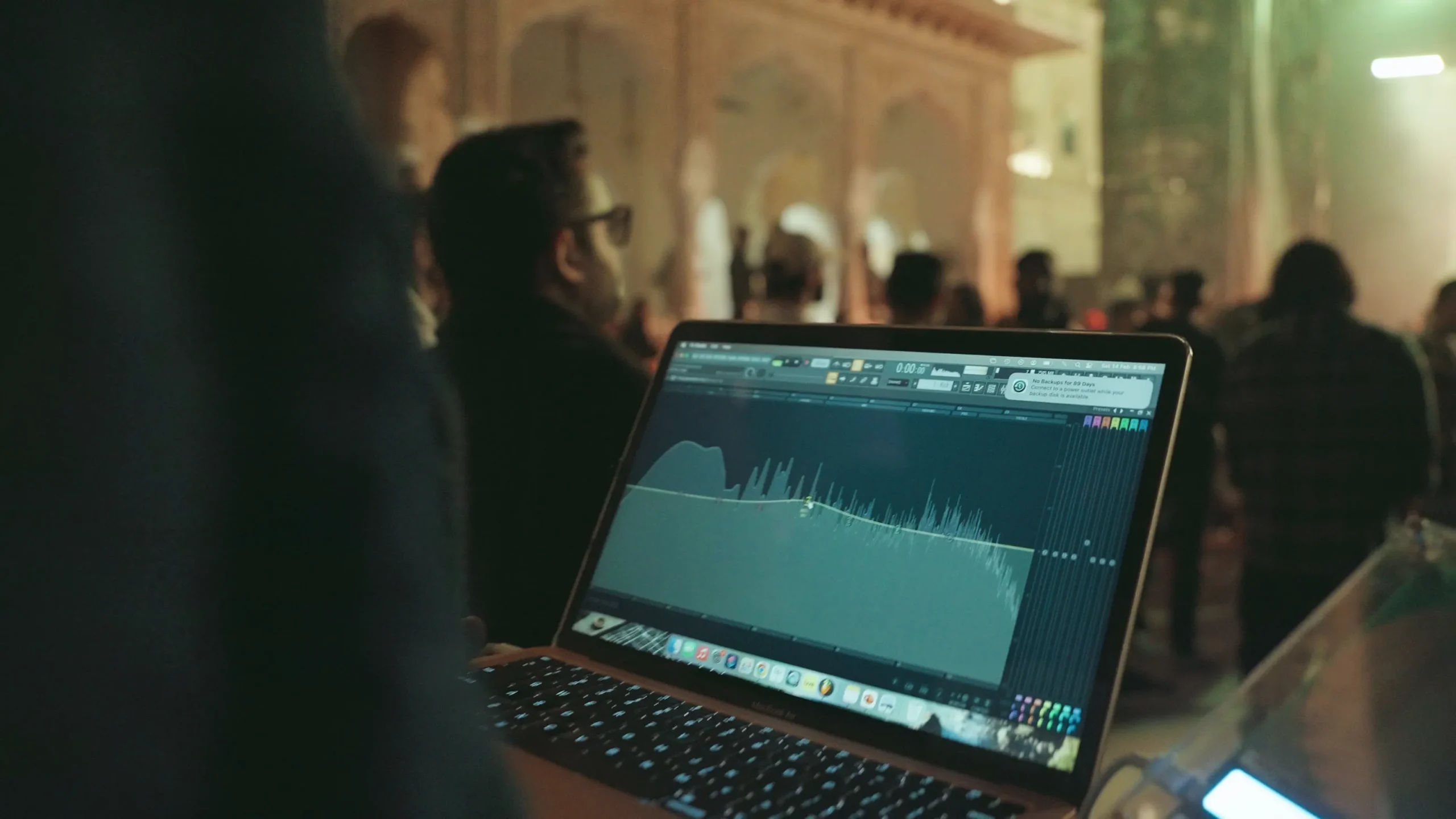
That’s exactly what Sarin could be seen doing while walking around Nomads by Magnetic Fields, the music festival that was held at the Abheygarh palace in the Rajasthani town of Khetri in February. In a video filmed in collaboration with Jameson Connects Jam Radio at the event, he uses a coin to pluck the decorative protrusions on one of the palace’s doors to generate a sound not unlike what one would hear from an Indian classical string instrument such as the santoor. Sarin says he didn’t know that would happen. “That’s what’s exciting about it,” he says. “Every time, I’m discovering something.”

Sarin’s work with Sonokinesis dates back to over a decade ago. To develop it, he drew on his collective knowledge of the physics and the psychology of music, and electronics and electrical engineering, all of which he studied in college. “For me, music has always been connected to technology,” says the artist, who as a teenager in the 1990s, broke open his old Walkmans and soldered the wires together to create a kind of mixer. As technology evolved, so did his experiments. In the 2010s, he hacked Microsoft’s motion sensing input device Kinect for Xbox to try making music with gestures.

Collabs

As somebody who had years of experience working with brands, Sarin realised early on that one of the most obvious uses of Sonokinesis would be to integrate it seamlessly into marketing efforts. It could be used to showcase products in a more subtle form of promotion through interactive music performances. “I felt brands are always like XYZ presents so-and-so band or performance; how can we integrate the product into the actual experience?”

Before he brought his skills to Abheygarh, he had “converted” the retail outlet of a luxury clothing label, a popular motorcycle brand and—-in his most ambitious project yet— an 1,100 foot long, 18-storey high Royal Caribbean cruise ship into musical instruments. He’s since taken a step back from the collabs to avert the risk of Sonokinesis “getting commoditised”, but was pleased to find that the Jameson Connects team gave him “complete creative freedom”. “They were like, you do what you want. We just film you,” says Sarin whose last album, which was released in 2013, was coincidentally called Connected.

Crowd control

Audience involvement has always been at the core of Sarin’s live electronic music performances. When he would play sets in bars and clubs during the early part of his career, he would invite members of the crowd up on stage and ask them to tap a bottle or strike a fork, and then use the sound as a sample to which he would add beats and create a track from scratch. “I didn’t like how electronic music [had been reduced to] DJs playing someone [else]’s songs and [making] heart symbols,” says Sarin. “I thought to myself: how can we make it more immersive?”

While live sampling is far more common these days, with Sonokinesis, he turns into something of a musical magician. “If I’m speaking at a conference, one of my favourite things to do is ask one of the attendees to bring an object up onto stage. Typically, they’ll get a glass or a handbag to which I connect the sensor and then tap it, and then ask them to tap it themselves. In those instances, I can set [certain parameters] so that no matter what they do, it will sound nice.”

Mapping the Earth

The second element of his collaboration was Sonic Veda, his “loosely-coined term for the science of sound” which he says is “a combination of electromagnetic frequencies and seismic readings” through which he could determine the vibration of the Earth or the land on which the festival was situated. He then used a ‘Schumann resonance generator’ to map the frequency that he had picked up off the festival site and the frequency of the people there. “We figured out that there’s a difference.”

What Sarin found was that “the vibration of the palace itself is quite different on its own in isolation versus when people fill up the place” and because Abheygarh is a newly-constructed palace, “the energy was quite fresh”, like a blank slate or tabula rasa. He says, “it was interesting to see how the crowd brought their own energy.”

He also discovered that some musical styles work better within the space. “That led me to another thought, which was what if the next edition of the festival or whatever event happens at that palace henceforth is curated in consonance with its inherent resonance? How can we create experiences that are consonant and in line with the natural vibration of a place?”The idea could potentially change the way festivals and concerts are currently programmed into thoughtful experiences that truly match the venue’s ‘vibe’.

For now, Sarin has set his sights on taking Sonokinesis and Sonic Veda global. He’s in conversations to visit monuments within India and around the world. His aim: “to actually unearth the frequency of different cities and places, and then ultimately, perhaps cross-pollinate them”. For example, mapping the frequencies emanating from the Taj Mahal and from Machu Picchu and how they “could work together”. “It would kind of be a world peace monument that’s larger than the sum of everything that we have.”

About the author

Amit Gurbaxani

Amit Gurbaxani is a Mumbai-based journalist who specialises in writing about the Indian music industry. He is the editor of the South Asia edition of the music business website Music Ally. He is also the co-founder/co-host of The Indian Music Charts Podcast, India’s leading music commentary podcast. A features writer for over two-and-a-half decades, Amit’s work can be read in several prominent publications, from India Today to The Hollywood Reporter to name just a few.