Indian Truck Art & Rolling Culture | Hand-Painted Art
Indian truck art showcases hand-painted designs, vibrant icons & cultural symbols, turning vehicles into moving canvases of creativity & tradition.
Trucks as Rolling Culture
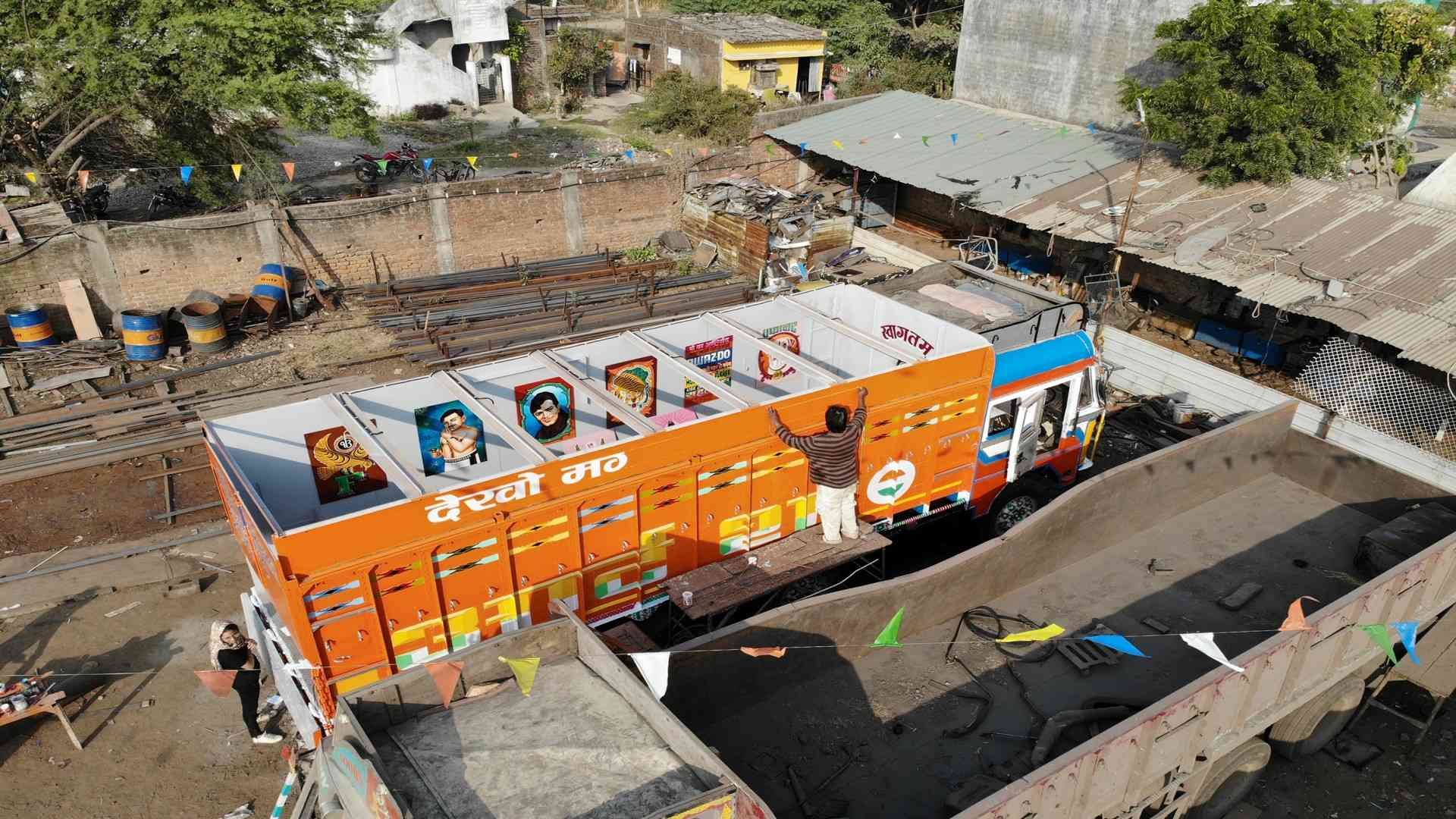
On India’s highways, trucks are more than logistics—they’re swagger. Hand-painted peacocks, punchline typography, saints, cinema, names of kids and lovers. It’s vernacular design with diesel in its veins. All India Permit (AIP), founded by designer and archivist Farid Bawa, treats these vehicles as what they are: rolling culture.
Roots in the Road
Bawa’s link to the road runs through his family. His grandfather, ran a transport business; Farid grew up in Nagpur around depots and paint fumes. As he puts it, “My grandfather, from what I’ve learned, used to drive trucks.” He adds, “He started Bawa Roadways in 1964.” The fascination struck early: “I always loved craft as a kid.”
Then the gloss began to peel. The hand-painted doors turned into radium stickers. Factory finishes crowded out human touch. Documentation was non-existent. “It’s funny—when a truck meets with an accident, they fix it again, paint on top, and it starts moving again.” The previous artwork disappears, as if it never existed. And public attention? “There are trucks on the highways, nobody’s looking at them,” so the artists’ stories stay invisible.
More Than Machines
For the drivers, though, these trucks are much more than machines. They spend weeks, sometimes months, on the road. The cabin becomes a second home, padded with mattresses, cushions from their houses, tiny shrines to the gods they believe will protect them. Horns blare Bollywood tunes; welcome signs hang over the dashboard. On the outside, the paint becomes an autobiography—family names, patriotic symbols, religious icons. In Bawa’s words, “Truck art is basically a representation of India, and different parts of India, actually.”
Beginning of All India Permit
AIP began as a counter to that erasure. Bawa launched it in 2017, commissioning truck and sign painters to create works on cold-rolled metal sheets—the same material used on trucks—and building a site to sell and show them. He moved to Amsterdam for design work, carried the canvases in a suitcase, and the project found momentum abroad and back home. Suddenly, “there was some kind of buzz around it,” and design schools, galleries, and curious audiences started paying attention.
From there, AIP kept switching canvases. Collaborations with Google, Vans, Levi’s, and Apple Music took truck art from yard to runway to playlist cover. A New Zealand brewery put the style on a chilli-chai stout. Exhibitions in Amsterdam and New York put unknown painters on international walls. In Doha, AIP and truck artists created “a typographic mural, which was really massive” for Qatar Museums, even as local rules had pushed hand-painted vehicles off the streets.
Dignity, Access, and Diversity
The point isn’t just visibility; it’s dignity and access. Truck yards are punishing spaces—male, remote, unsafe. “It’s rough. It’s really remote.” Working with Mumbai-based NGO Tiny Miracles, AIP ran a workshop that trained women and then put brushes in their hands on an actual truck—India’s first women-led truck-painting project. The joy was the tell: “And now they’re teaching Googlers.”
If you think of truck art as one style, you’re missing the whole convoy. It’s local by design. A Rajasthan truck borrows miniature-painting flourishes. Down South, the letterforms shift languages and the pantheon changes. “A truck from South looks totally different from North and East and West and Central.” Each route is a cultural map.
AIP’s archiving work with Google Arts & Culture is building an online record before more of that map gets paved over. Bawa is also working on a book, school programs, and workshops that let artists teach the techniques usually learned in yards, not classrooms. One early AIP project was a genius proof of concept: he bought an old truck, turned its cargo hold into a gallery, and drove it across design schools and dhabas. Inside the rig, “you could actually walk in and see the exhibitions,” and “we drove like 1200 kilometers.” Instant museum. Zero marble.
Expanding the Cultural Highway
Bawa’s field notes stretch beyond India’s borders—Suriname, Buenos Aires, Sicily, Pakistan—where vehicle decoration carries different histories but the same impulse: make the machine yours. Living abroad sharpened his lens. “Living in Amsterdam, I respect Indian culture even more,” he says. That has spilled into All India Stereo, his side project that digs up vintage Indian records and throws gatherings where music, food, and visual culture talk to each other.
Also Read: Musical Soul of Northeast India: A Deep Connection with Western Music
Through it all, the brief hasn’t changed. As Bawa puts it, “The bigger mission is just to document and create new projects and promote the art form.” AIP does the paperwork, the platforms, and the partnerships so truck and sign painters can keep doing what they do best—turn freight into feeling.
This is the story: a living tradition that never needed permission. The trucks will keep moving. Thanks to All India Permit, the art—and the artists—won’t be left in the rear-view.
The views expressed are those of the author and do not reflect the opinions of Jameson Connects.
Takshi Mehta
Takshi Mehta is an independent journalist who writes about culture, entertainment, and lifestyle. You can check out her work at @takshimehta on Twitter and Instagram.
Jam Radio
Our Editorial Platform
Bringing you the best of culture, through exclusive stories from our community